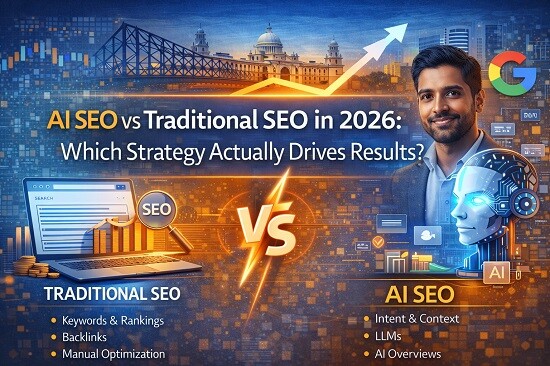
Search engine optimization has entered a new era. By 2026, search is no longer driven solely by blue links and keyword rankings. With AI-powered search engines, answer engines, and large language models (LLMs) shaping how users discover information, businesses are rethinking their SEO strategies.
This has sparked an important question: Does traditional SEO still work, or has AI SEO taken over?
The answer lies in understanding how both approaches differ—and how they perform in today’s AI-first search landscape.
What Is Traditional SEO?
Traditional SEO focuses on optimizing websites to rank higher in search engine results pages (SERPs) using established techniques such as:
- Keyword research and placement
- On-page optimization (titles, meta tags, headings)
- Backlink building
- Technical SEO (site speed, crawlability)
- Content optimization for rankings
This approach has been highly effective for years and still forms the foundation of search visibility.
What Is AI SEO?
AI SEO is an evolution of traditional SEO designed for AI-driven search systems. It focuses on optimizing content so that search engines powered by machine learning and LLMs can understand, extract, and recommend it.
AI SEO prioritizes:
- Search intent and context
- Answer-focused, conversational content
- Topical authority and content depth
- E-E-A-T (Experience, Expertise, Authority, Trust)
- Structured data and semantic clarity
Rather than just ranking pages, AI SEO aims to become the source AI trusts and cites.
Key Differences Between AI SEO and Traditional SEO
1. Keywords vs Context
- Traditional SEO: Targets specific keywords and variations
- AI SEO: Understands meaning, relationships, and intent behind queries
In 2026, search engines interpret natural language far more effectively, making context more important than exact keywords.
2. Rankings vs Visibility Everywhere
- Traditional SEO: Focuses on SERP rankings
- AI SEO: Focuses on visibility across AI overviews, voice search, and answer engines
Being “ranked” matters less if AI answers the query without users clicking links.
3. Page Optimization vs Topic Authority
- Traditional SEO: Optimizes individual pages
- AI SEO: Builds topic clusters and subject-matter authority
AI systems favor brands that demonstrate consistent expertise across an entire topic.
4. Content Length vs Content Usefulness
- Traditional SEO: Often emphasizes word count and keyword density
- AI SEO: Emphasizes clarity, accuracy, and usefulness
AI rewards content that directly solves user problems.
5. Manual Optimization vs Intelligent Optimization
- Traditional SEO: Relies heavily on manual analysis
- AI SEO: Uses machine intelligence for insights, predictions, and optimization
AI SEO adapts faster to search behavior changes.
What Still Works from Traditional SEO in 2026?
Despite major changes, traditional SEO is not obsolete. In fact, it remains essential.
Still relevant:
- Technical SEO fundamentals
- Site structure and internal linking
- Page speed and mobile optimization
- High-quality backlinks
- Well-written, original content
Traditional SEO provides the infrastructure that AI SEO builds upon.
Why AI SEO Works Better in 2026
AI SEO aligns with how modern search engines function. By 2026, search engines:
- Generate answers instead of lists
- Prioritize trusted sources
- Learn from user engagement
- Understand natural language deeply
AI SEO helps brands:
- Appear in AI-generated answers
- Gain authority beyond rankings
- Reduce dependency on paid ads
- Improve long-term organic ROI
It’s not about tricking algorithms—it’s about earning trust.
The Smart Approach: Hybrid SEO in 2026
The most successful strategy in 2026 is not choosing between AI SEO and traditional SEO—it’s combining them.
A hybrid SEO strategy includes:
- Traditional SEO for technical health and discoverability
- AI SEO for intent, authority, and answer optimization
- Content designed for humans and machines
- Structured data for AI understanding
This balanced approach ensures visibility across all search formats.
How Businesses Should Adapt Their SEO Strategy
To stay competitive in 2026:
- Shift from keyword-first to intent-first content
- Build topic authority instead of isolated pages
- Optimize for AI summaries and voice search
- Strengthen E-E-A-T signals
- Continuously update and refine content
SEO is no longer static—it’s an ongoing intelligence-driven process.
Final Thoughts
In 2026, traditional SEO alone is not enough, but it is still necessary. AI SEO is what turns visibility into dominance in an AI-driven search ecosystem.
Businesses that embrace AI SEO while maintaining strong traditional SEO foundations will outperform competitors who cling to outdated tactics.
The future of SEO belongs to brands that understand one truth:
Search engines are getting smarter—and your SEO strategy must too.
By 2026, AI-powered and generative search engines are changing how content is discovered, making SEO with GEO (Generative Engine Optimization) essential for brands that want visibility inside AI-generated answers—not just traditional rankings.
Leave a Reply