
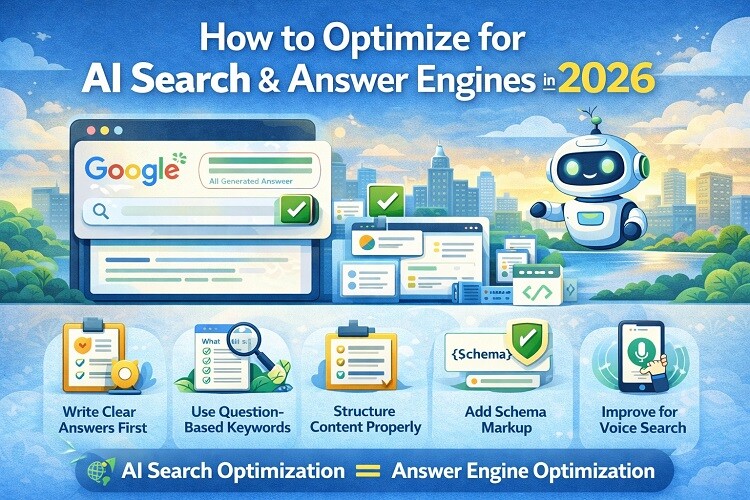
How to Optimize for AI Search & Answer Engines in 2026
Search is no longer limited to blue links. In 2026, users are getting answers directly from AI-powered search engines, Google AI Overviews, voice assistants, and chat-based tools. This shift has changed how websites need to optimize their content.
To stay visible, businesses must move beyond traditional SEO and start focusing on AI Search Optimization and Answer Engine Optimization (AEO).
What Is AI Search?
AI search uses advanced machine learning models to:
- Understand the intent behind a query
- Summarize information from multiple sources
- Provide direct answers instead of just listing websites
Examples of AI search include:
- Google AI Overviews
- Voice assistants (Google Assistant, Alexa)
- AI chat-based search tools
What Are Answer Engines?
Answer engines are systems that:
- Pull direct answers from web pages
- Display them as snippets, summaries, or spoken responses
- Prefer clear, trustworthy, and well-structured content
Your goal is to make your content easy for AI to understand and reuse.
SEO vs AEO: What’s the Difference?
| Traditional SEO | Answer Engine Optimization |
|---|---|
| Focus on rankings | Focus on answers |
| Keyword-driven | Question-driven |
| Click-based traffic | Visibility-based presence |
| Long-form content | Clear, concise explanations |
In 2026, SEO + AEO together deliver the best results.
Why Optimizing for AI Search Is Important
- AI answers reduce website clicks
- Only trusted sources get selected
- Early adopters gain authority and visibility
- Brand presence increases even without direct traffic
Businesses that ignore AI search risk becoming invisible.
How to Optimize Content for AI Search & Answer Engines
1. Write Clear Answers First
AI prefers content that answers questions quickly.
Best practice:
- Start sections with a direct answer
- Follow with explanation and examples
Example:
“Answer Engine Optimization is the process of optimizing content so AI tools can extract and display clear answers.”
2. Use Question-Based Keywords
Target keywords people actually ask:
- What is…
- How does…
- Why is…
- Best way to…
These perform well in AI summaries and voice search.
3. Structure Content Properly
AI understands structured content better.
Use:
- Clear H2 and H3 headings
- Bullet points and numbered lists
- Short paragraphs
- FAQ sections
4. Add Schema Markup
Schema helps search engines understand your content.
Most useful schemas:
- FAQ schema
- How-To schema
- Article schema
- Local business schema
This increases your chances of appearing in AI answers.
5. Improve Content Trust (E-E-A-T)
AI engines prioritize trusted content.
Build trust by:
- Adding author credentials
- Showing real experience and examples
- Updating content regularly
- Linking to authoritative sources
6. Optimize for Voice Search
Voice queries are conversational and longer.
Tips:
- Use natural language
- Answer in complete sentences
- Optimize for “near me” and local queries
7. Create Topic Clusters (Not Just Single Pages)
AI prefers content depth and authority.
Instead of one page:
- Create a main pillar page
- Support it with related blogs
- Interlink them naturally
Common Mistakes to Avoid
❌ Writing vague or generic content
❌ Overusing AI-generated text without editing
❌ Ignoring schema markup
❌ Keyword stuffing
❌ Not updating old content
How Simple SEO Helps With AI Search Optimization
At Simple SEO, we help businesses:
- Create AI-friendly content
- Optimize for AEO and featured snippets
- Structure pages for AI understanding
- Improve local and brand authority
Our approach focuses on long-term visibility, not short-term tricks.
Final Thoughts
AI search is not the future—it’s the present. In 2026, websites that provide clear answers, structured content, and real value will dominate search results.
If you want your website to be visible in AI-powered search and answer engines, now is the time to optimize.
Leave a Reply